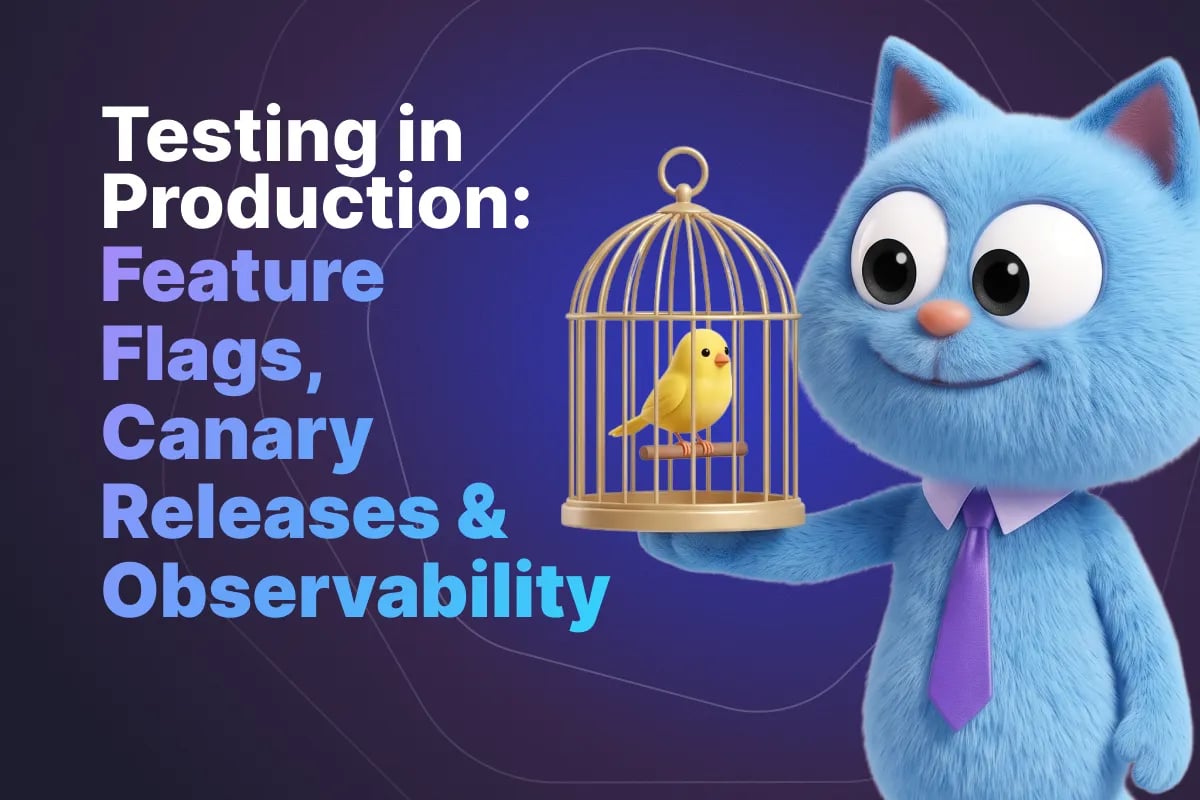
Testing in Production: Feature Flags, Canary Releases and Observability in 2026

The Quick Answer
Testing in production means deliberately using the live environment as a place to gather evidence about quality - behind flags, on a fraction of traffic, with instrumentation good enough to see what happened and a switch fast enough to undo it.
This is the mirror image of shift-left testing, not its opposite. Shift-left moves feedback earlier, to where defects are cheapest to fix. Testing in production extends feedback later, to where the conditions are real. Teams that do both have a signal across the whole lifecycle; teams that do only one have a blind spot at one end of it.
What it is not: skipping pre-release testing, or letting customers find your bugs. Everything that can be verified before release still should be. This is about the residual class of failures - real data, real scale, real integrations, real user behavior - that no pre-production environment reproduces.
This article covers why staging fails to represent production, how feature flags convert deployment into a testing instrument, how canary releases limit blast radius, what observability gives QA that a test report cannot, and the guardrails without which this becomes reckless.
Why Staging Will Never Be Enough
The argument for testing in production is not that pre-production testing is unnecessary. It is that a specific set of conditions cannot be replicated before release, at any budget.
Data. Production data is larger, older and stranger than anything you seed. It contains records created by versions of the software that no longer exist, migrations that half-applied, unicode nobody anticipated, and accounts whose shape violates assumptions the current code makes. A query that is fast on two hundred thousand rows behaves differently on forty million, and the row that breaks the export is one specific customer's.
Scale and concurrency. Staging has neither the traffic volume nor the simultaneity. Race conditions, connection-pool exhaustion, cache stampedes and lock contention are properties of load, and load tests approximate them at best.
Integrations. Third-party sandboxes are not the third party. They have different latency, different rate limits, different error behavior and a different version deployed. Payment providers, identity providers and shipping APIs all behave differently in anger.
Users. Real users do things your test cases do not: leave a tab open for nine days, use the browser back button mid-transaction, run three ad blockers, arrive on a device you did not know was still in use, and use the feature in a way the product manager did not intend.
Configuration drift. Even disciplined teams accumulate differences - environment variables, feature flag states, DNS, TLS, CDN rules, third-party keys. The claim "it worked in staging" is only as strong as the claim that staging matches production, and that claim decays continuously.
None of this argues for testing less before release. It argues that after a release there is still something to find out, and that the choice is between finding it deliberately or waiting for a customer to.
Feature Flags as a Testing Tool
A feature flag separates deploying code from exposing behavior. That separation is what makes everything else in this article possible: code can be in production, exercised, and observed, before any customer is affected by it.
For QA, this changes several things at once:
- You can test the real thing in the real place. A flag scoped to internal accounts lets QA exercise the feature against production data and production integrations before anyone else sees it.
- Merges stop waiting for readiness. Incomplete work ships dark, which shortens branches and reduces the integration pain that long-lived branches cause.
- Rollback becomes a configuration change. Turning a flag off takes seconds and carries none of the risk of a redeploy. This is the single largest reduction in the cost of being wrong.
- Exposure becomes a dial. The same mechanism that hides a feature can reveal it to 1% of users, which is what a canary release is.
The discipline that keeps this from becoming a liability is treating flags as inventory with a lifecycle. Every release flag needs an owner and a removal date; flags that outlive their purpose multiply the code paths in production, and a system with sixty stale flags has a combinatorial state space that nobody has tested and nobody can reason about. Separate the short-lived release flags from the long-lived operational ones (kill switches, entitlement gates) and hold the first category to a hard expiry.
Flags also need to be tested themselves. At minimum, verify both states of a flag before rollout, and verify that turning it off actually restores the previous behavior. A flag whose off-path has silently rotted is worse than no flag, because you will reach for it during an incident.
Progressive Delivery: Canary and Staged Rollout
A canary release exposes a change to a small slice of production traffic, compares that slice against the rest, and promotes or aborts based on what the comparison shows. The value is not that it prevents failures: it is that it bounds them.
A typical progression looks like internal users, then 1% of traffic, 5%, 25%, 50% and 100%, with a bake time at each step long enough for the relevant signal to appear. Choosing that bake time is the part teams get wrong. A latency regression shows up in minutes; a memory leak takes hours; a defect in a weekly billing job takes a week. The bake time has to match the slowest signal you care about, not the fastest.
Define promotion criteria before you start, in numbers. Error rate, latency at the 95th and 99th percentile, and at least one business metric - conversion, sign-ups, transactions per minute - compared against the control group rather than against an absolute threshold. Comparison matters because production is noisy; an absolute error-rate limit tells you nothing on a day when everything is slightly worse.
Automate the abort. A canary that requires a human to notice and decide has traded a large fast failure for a small slow one. The rollback trigger should be as automatic as the promotion.
Two considerations shape how you slice traffic. Consistency: a user must stay on one side of the split for the duration, or you will get bug reports describing behavior that alternates. And representativeness: 1% of traffic chosen by geography or by a single availability zone is not 1% of your users, and a canary that misses your mobile traffic or your enterprise tenants proves less than it appears to.
What Observability Gives QA
Testing in production is only responsible if you can see what happened. Observability is the difference between a controlled experiment and an uncontrolled one, and it is the capability most teams underinvest in before they start.
Monitoring answers questions you knew to ask: is the error rate above two percent. Observability is the property that lets you answer questions you did not anticipate: why are checkout failures concentrated among users on one payment method who signed up before a particular date? For QA the practical consequence is that production stops being a black box and becomes a source of evidence.
| Signal | What it answers | QA use |
|---|---|---|
| Metrics | What is the rate, and is it different from before? | Canary comparison, regression detection, release health |
| Logs | What exactly happened in this case? | Reproducing a production defect, confirming a fix |
| Traces | Where did the time go across services? | Locating the service responsible for a slow path |
| Events | What did the user actually do? | Finding unanticipated flows worth testing |
Three practices make this usable rather than decorative. Correlate by request: a trace id that spans services turns three separate investigations into one. Attach the release and flag state: every event should carry the version and the variant, or you cannot attribute anything to a change. Instrument the assertion, not just the error: the interesting production signals are often successes with the wrong shape, such as an order created with a zero total or a search returning no results for a common term, and those need to be emitted deliberately.
There is a feedback loop here worth using. Production behavior tells you which flows are actually common, which failure modes actually occur, and which edge cases are real rather than imagined, and that should redirect where the pre-release suite spends its effort. A test suite informed by production data covers what users do; one written only from requirements covers what they were expected to do.
Synthetic Monitoring and Production Smoke Tests
The most direct form of testing in production is running tests against it: a small suite of scripted journeys executed on a schedule from outside the system.
These are not regression tests. The suite should be short and cover only the paths whose failure constitutes an incident: sign in, search, add to cart, checkout, the primary API call. Ten to twenty checks, running every few minutes, from more than one region.
The two design constraints are read-safety and cleanup. Synthetic journeys that write need dedicated test accounts, clearly flagged data, exclusion from analytics and billing, and a cleanup path that runs even when the test fails halfway. The alternative, synthetic orders leaking into revenue reports or test users appearing in a customer's account list, is a reliable way to lose permission to do this at all.
Alerting on them requires care. A single failure from one region is usually the network; the alert should fire on a pattern, not on one red run. And when it does fire, the value comes from having the run history in one place, so that "checkout has failed intermittently from eu-west since Tuesday" is visible as a trend rather than as a series of isolated notifications. Keeping synthetic results alongside the rest of your test reporting is what makes that trend legible.
Testing With Real Users: Dark Launch, Shadow Traffic and Experiments
Beyond canaries, three techniques put real traffic against new code without exposing users to the result.
Dark launching runs the new code path in production without surfacing its output. A new pricing engine calculates alongside the old one; only the old result is returned; the two are compared and logged. This is the strongest available evidence for a replacement component, because it is validated against the complete distribution of real inputs rather than against the cases you thought to write.
Shadow traffic mirrors live requests to a new service version and discards the responses. It answers questions about behavior and performance under genuine load and genuine input variety. The care required is on the write path: mirrored requests must not touch production data or trigger real side effects such as emails, charges or downstream calls.
Experiments, or A/B tests, are usually framed as product tools, but they are also quality instruments. A variant that reduces conversion or increases errors has failed a test, whatever the product hypothesis was, and QA should be reading the guardrail metrics on every experiment for exactly that reason.
All three share a prerequisite: a reliable way to compare two behaviors on the same input. Without that comparison, you are running new code in production and calling it a test.
Guardrails: Doing This Safely
Testing in production is a discipline with preconditions. Without them it is not a practice, it is an excuse.
- An instant, rehearsed rollback. Flag off or traffic shifted back, in seconds, executed by whoever is on call without needing the author. Rehearse it; a rollback path that has never run is a hypothesis.
- Observability before exposure. Instrumentation, dashboards and alerts must exist before the first 1% of traffic, not after the first incident.
- Blast radius chosen deliberately. Internal users first, then a small slice that excludes your highest-value accounts by default.
- No experiments on irreversible actions. Payments, data deletion, communications sent to customers and anything with a regulatory footprint are not canary material. Use dark launch and comparison instead.
- Test data segregated end to end. Synthetic and internal traffic must be excluded from analytics, billing, ML training data and customer-visible aggregates.
- Privacy honored. Production testing touches real personal data; access control, log redaction and regional restrictions apply exactly as they do elsewhere.
- Someone accountable and watching. Every rollout has a named owner who is online for the exposure window and empowered to abort without a meeting.
The clearest failure mode is a team that adopts the vocabulary without the guardrails: flags with no owners, canaries with no comparison, and observability that consists of a dashboard nobody opens. That team has not started testing in production; it has stopped testing.
Where QA Fits
The role does not disappear when testing extends past release; it extends with it. In practice QA owns four things in this model.
Defining what success looks like. The promotion and abort criteria for a rollout are test oracles, and writing precise, falsifiable ones is a testing skill rather than an operations skill.
Testing the mechanisms. Flags in both states, the off-path actually restoring prior behavior, the canary routing being consistent and representative, the rollback working. The safety net needs its own tests.
Watching the rollout. Someone has to interpret the comparison, distinguish a real regression from noise, and make the call. That is analysis, not monitoring, and it benefits from knowing what the change was supposed to do.
Feeding production back into the suite. Every escaped defect becomes a test case, every unanticipated flow found in event data becomes a scenario, and the pre-release suite gets steadily better at representing reality. This is also where the two halves connect: production tells you what to shift left next.
Conclusion
Testing in production is not an admission that pre-release testing failed. It is recognition that a specific class of failure - real data, real scale, real integrations, real users - only exists in one place, and that the choice is between meeting it deliberately with flags, canaries and instrumentation, or meeting it accidentally through a support ticket.
The practice rests on three capabilities. Feature flags, so exposure is independent of deployment and reversible in seconds. Progressive rollout with a comparison against a control, so failures are bounded and detected rather than merely survived. And observability good enough to answer questions you did not know to ask, so a rollout produces evidence rather than reassurance.
It works as a complement to shifting left, not as a substitute. Early testing keeps defects cheap; production testing keeps them honest. The teams that run both end up with the same defect data pointing in both directions: production incidents becoming pre-release test cases, and pre-release coverage focused on what users actually do.
Making that loop real means the results from both ends living in one system. QA Sphere holds pre-release test cases, scheduled production checks pushed in from CI, and the reporting that shows both together, with defects linked back to the cases that found them through issue tracker integration. See pricing or book a demo.

Written by
QA Sphere TeamThe QA Sphere team shares insights on software testing, quality assurance best practices, and test management strategies drawn from years of industry experience.