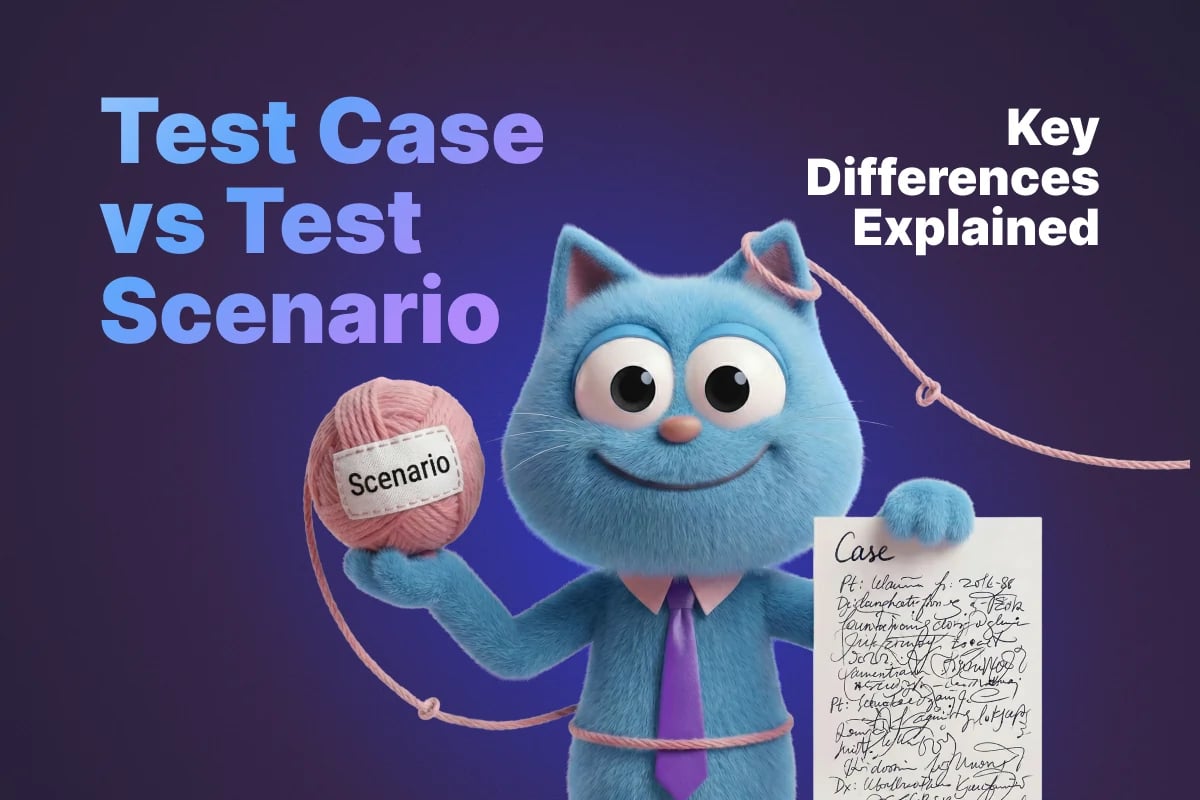
Test Case vs Test Scenario: Key Differences Explained

If you have spent any time in QA, you have probably heard "test case" and "test scenario" used interchangeably. They are not the same thing, and mixing them up creates real problems — from bloated test libraries to incomplete coverage and confused handoffs between team members.
This guide breaks down exactly what each term means, how they relate to each other, and when to use one over the other in your day-to-day testing work.
What Is a Test Scenario?
A test scenario is a high-level statement that describes what needs to be tested. It captures a user goal or a piece of functionality without going into step-by-step detail. Think of it as the "what" of testing.
Test scenarios are typically one-liners derived from requirements, user stories, or business rules. They describe the behavior that matters from the user's perspective.
Examples of test scenarios:
- Verify that a user can register a new account.
- Verify that a user can reset their password.
- Verify that a promo code is applied correctly at checkout.
- Verify that the API rejects requests without authentication.
Notice how none of these mention specific inputs, steps, or expected outputs. That level of detail belongs in test cases.
What Is a Test Case?
A test case is a detailed, executable set of instructions that tells a tester exactly how to validate a specific behavior. It includes preconditions, step-by-step actions, test data, and a clear expected result.
Where a test scenario says "test password reset," a test case spells out every action from clicking "Forgot Password" to entering a new password and verifying the confirmation message.
If you want a deeper dive into writing them well, our guide on how to write test cases covers the full process.
Test Case vs Test Scenario: Side-by-Side Comparison
Here is the clearest way to see how these two concepts differ:
| Aspect | Test Scenario | Test Case |
|---|---|---|
| Definition | What to test | How to test it |
| Detail level | High-level, one-liner | Step-by-step with inputs and expected results |
| Derived from | Requirements, user stories, business rules | Test scenarios |
| Scope | Broad — covers a feature or workflow | Narrow — validates one specific condition |
| Includes test data | No | Yes |
| Includes expected result | Implied, not explicit | Explicitly stated |
| Time to create | Minutes | Longer — detailed steps take more time to write |
| Maintenance effort | Low — rarely changes unless the feature does | Higher — UI or flow changes require updates |
| Who typically writes | QA lead, BA, or senior tester during planning | QA engineer during test design |
| Relationship | One scenario maps to many test cases | Each test case belongs to one scenario |
The simplest way to remember this: a test scenario is a question ("Can the user log in?"), and test cases are the experiments that answer it ("Log in with valid credentials," "Log in with an incorrect password," "Log in with a locked account").
How One Test Scenario Becomes Multiple Test Cases
This is where the relationship becomes concrete. Take a single test scenario and see how it expands:
Test Scenario: Verify that a user can log in to the application.
Test Cases derived from this scenario:
| # | Test Case Title | Type |
|---|---|---|
| 1 | Log in with valid email and password | Positive |
| 2 | Log in with incorrect password | Negative |
| 3 | Log in with unregistered email | Negative |
| 4 | Log in with empty email field | Boundary |
| 5 | Log in with empty password field | Boundary |
| 6 | Log in with a locked account | Negative |
| 7 | Account lockout triggered after three consecutive failed attempts | Security |
| 8 | Session persists across restart when "Remember me" is checked | Functional |
One scenario, eight test cases. Each case targets a different condition, data set, or risk. This is exactly why both concepts exist — scenarios keep your coverage map readable, and cases keep your execution precise.
For a deeper look at structuring cases like these, see our guide on writing effective test cases with templates.
When to Use Test Scenarios
- Early planning. When a sprint starts and the team needs to identify what areas of the product need testing before writing detailed cases.
- Coverage mapping. When you want a quick overview of which features and workflows have test coverage and which do not.
- Stakeholder communication. Scenarios are readable by product managers, developers, and non-QA team members. They show testing scope without the noise of step-by-step details.
- Exploratory testing. When testers need direction but not rigid scripts, a list of scenarios provides focus without constraining how the tester explores.
When to Use Test Cases
- Structured execution. When a tester — especially someone new to the team — needs to run a test exactly as designed and report a clear pass or fail.
- Regression suites. Repeatable test cases ensure that previously working features stay working after every release.
- Compliance and audit. Regulated industries require documented evidence of what was tested, how, and what the result was. Scenarios alone do not satisfy this.
- Handoffs. When the person writing the test is not the person executing it, detailed cases eliminate guesswork.
Do You Need Both?
Yes. Skipping scenarios means you jump into writing test cases without first mapping out what needs coverage — and you end up with 200 cases for the login screen and zero for the billing flow. Skipping cases means you know what to test but have no repeatable, verifiable way to do it.
The practical workflow looks like this:
- Start with scenarios to map coverage across features and user journeys.
- Prioritize scenarios by business risk and user impact.
- Write detailed test cases for the scenarios that matter most.
- Use scenarios as-is for lower-risk areas where exploratory testing is enough.
This approach gives you broad coverage without drowning in documentation for every edge case of every feature. Our test case management guide covers how to maintain this balance as your library grows.
How to Manage Scenarios and Cases Together
The biggest pain point teams hit is not understanding the difference — it is managing both effectively. Scenarios live in one spreadsheet, cases live in another, and nobody can tell which cases map to which scenarios.
A good test case management setup solves this by letting you organize cases under scenarios, tag them by feature and type, and run them as part of structured test runs.
In QA Sphere, you can group test cases by folder or module, link them to features, and track execution results — so the relationship between "what to test" and "how to test it" stays visible as your library scales.
Key Takeaways
- A test scenario defines what to test. A test case defines how to test it.
- One scenario produces multiple test cases covering positive, negative, boundary, and edge conditions.
- Use scenarios for planning and coverage mapping. Use cases for execution and reporting.
- You need both. Scenarios without cases lack precision. Cases without scenarios lack direction.
- Manage them together in a structured system to keep the relationship clear as your test library grows.

Written by
QA Sphere TeamThe QA Sphere team shares insights on software testing, quality assurance best practices, and test management strategies drawn from years of industry experience.