
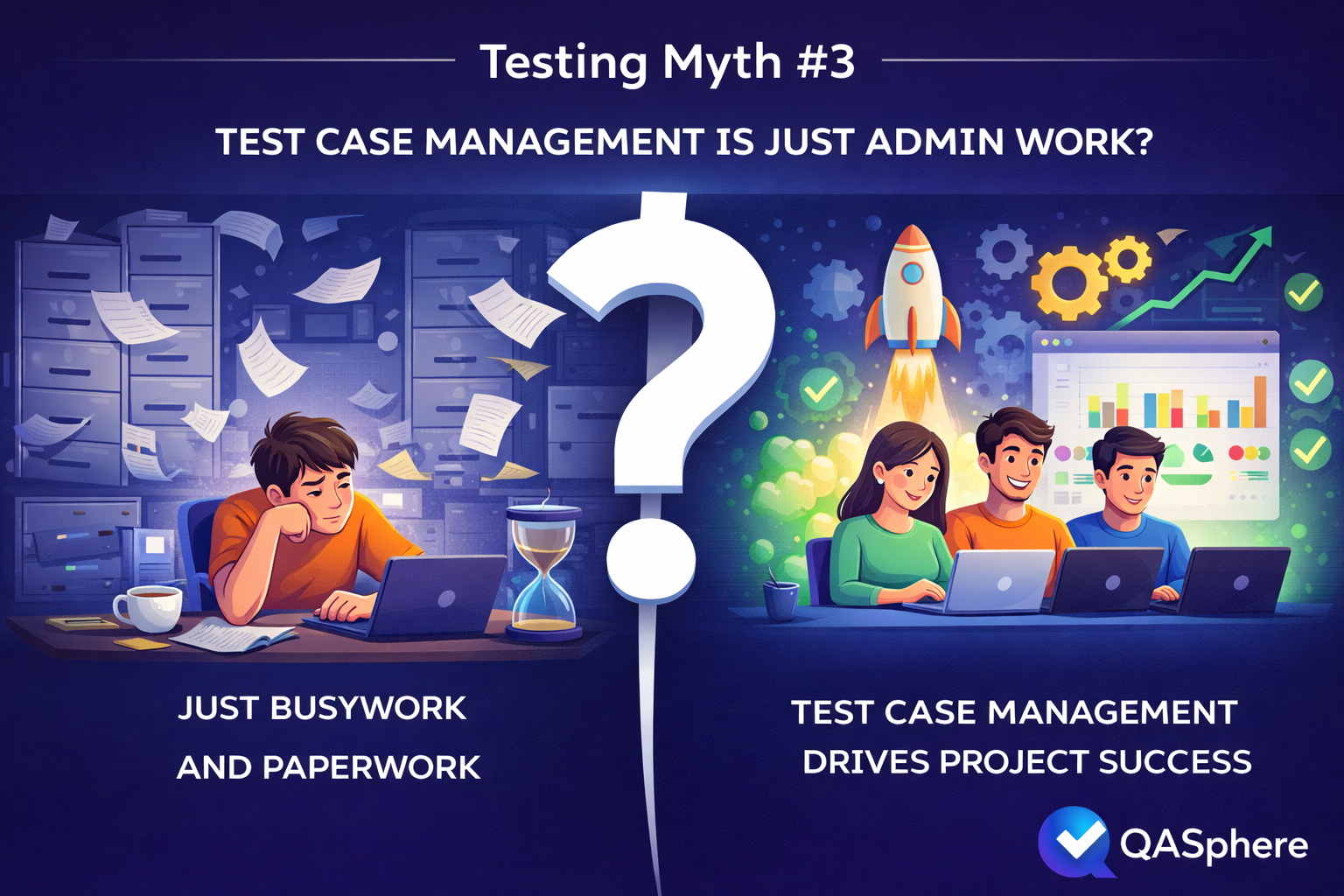
Testing Myths #3: Test Case Management Is Just Admin Work

Part of the Testing Myths series. Testing Myths #3.
What happens when the only person who knows the critical payment test scenarios goes on leave?
Not a hypothetical. In teams without shared structure, this scenario is a regular event. Someone gets sick, moves to another team, or simply has a busy sprint. The knowledge goes with them. The next release either waits, or proceeds with less coverage than anyone will admit in the post-mortem.
That is what test case management actually prevents. Not the existence of documentation. The absence of a single point of failure in how a team understands what it is protecting.
The real cost of "no system"
The teams that reject test case management are not wrong that bad documentation wastes time. They are wrong about what they save by avoiding structure entirely.
The first thing they lose is distributed ownership. One tester carries the payment flows. Another remembers the permissions edge cases that caused the incident two quarters ago. A senior engineer keeps the migration checks in their head because they were burned by them. This works until it does not, and the moment it stops working is always inopportune: a release deadline, a handoff, an unexpected absence. Life Without Software Test Management Systems catalogues this failure mode in detail. The pattern is consistent across team sizes.
The second loss is subtler. Without organized coverage, prioritization becomes guesswork. When everything lives in someone's mental model or an unstructured spreadsheet, all tests appear equally important until a release crunch forces a triage that no one is prepared for. Which scenarios are critical for this change? Which cases are outdated? Which bugs should trigger retesting? Those questions have answers, but only if the suite is organized enough to surface them. When it is not, the release preparation cost shows up every cycle, quietly, as scramble and coordination overhead rather than as a line item anyone can point to.
The third loss compounds the other two: the team stops accumulating institutional knowledge about product risk. A test suite is not just a checklist. Over time it becomes a record of where the product has surprised the team, where edge cases live, what the critical paths actually are versus what anyone assumed they were. When that record exists only in people's heads, it degrades. People leave. Memory fades. The same bugs resurface. The team repeats work it has already done because there is no artifact connecting past failures to current coverage.
Why the skepticism exists
None of this means the skeptics are arguing in bad faith. They have usually seen the worst version of structured testing practice: giant repositories that nobody trusted, fields filled out to satisfy audits rather than to help anyone, endless debates about case formatting while the actual test quality stagnated.
That experience produces a reasonable but wrong conclusion. Teams look at bad repositories and decide the problem is test case management itself. Usually the real problem is that the repository stopped serving the work. It became a compliance artifact, a dumping ground, or a graveyard of old cases nobody had the discipline to retire.
That distinction is what the myth collapses. Bad case management is waste. The conclusion that all case management is waste follows only if you assume the bad version is the only version.
What good looks like
A healthy case library is usually smaller and more intentional than teams expect.
It distinguishes between reusable core scenarios and one-off execution notes. It uses sections, tags, and priorities to create signal rather than clutter. When a feature changes significantly, outdated cases get archived rather than left to confuse the next person. Coverage for manual testing and automated testing is tracked in the same place rather than treated as separate concerns that happen to involve the same product.
The practical effect is visible across team roles. New testers ramp faster because the critical coverage is explicit rather than oral. Developers understand what QA is protecting and can make better decisions about where to add their own checks. Product managers see something more useful than a test count: a view of which areas are well covered, which are thin, and which changes carry the most risk. Release discussions move away from status-chasing and toward actual confidence assessment.
For teams that want to improve the quality of the cases themselves rather than just their organization, How to Write Effective Test Cases With Templates addresses the writing side of the problem. Structure and clarity reinforce each other. A well-organized repository of poorly written cases is still a liability.
Structure as a multiplier
Test case management in QA Sphere is built around the premise that structure should reduce friction rather than create it. Tags, priorities, and ownership make the suite navigable. Sections map coverage to product areas in a way that supports both daily decisions and release-level reviews.
Reporting and issue tracker integration extend the value further. A test case that connects to execution history and linked defects tells a different story than one sitting in isolation. When a bug resurfaces, you can see whether the relevant scenario existed, whether it was run, and what happened. That is the kind of traceability that prevents repeated surprises.
AI-assisted case creation fits into this picture as a way to accelerate drafting, not as a replacement for judgment. The value of AI-generated cases depends almost entirely on what happens after generation: review, categorization, and integration into a repository that has context. Generated cases that land in a structured suite become useful quickly. Generated cases that pile up as disconnected artifacts add to the problem rather than solving it.
Teams that treat test case management as admin typically pay for it in the next major release, or the one after that, when the knowledge gaps and coverage blind spots finally become visible. The decision to skip structure is not neutral. It transfers the cost somewhere else: slower releases, repeated mistakes, too much depending on who happens to be available. That is a trade worth understanding before making it.