
The Automation Dilemma: How to Make Manual QA More Efficient Without Full Automation

Practical Tips for Efficiency Gains
So, how do you put this into practice without things getting messy? Here are a few quick tips:
Use Tags Wisely
Instead of creating complex workflows to track test status, use tags to indicate which tests are "manual," "automated," or "plan to automate." Tags are flexible, easy to set up, and don't require any advanced configuration. Just be careful not to over-tag—keep it simple to avoid confusion.
Automate What You Can, But Be Strategic
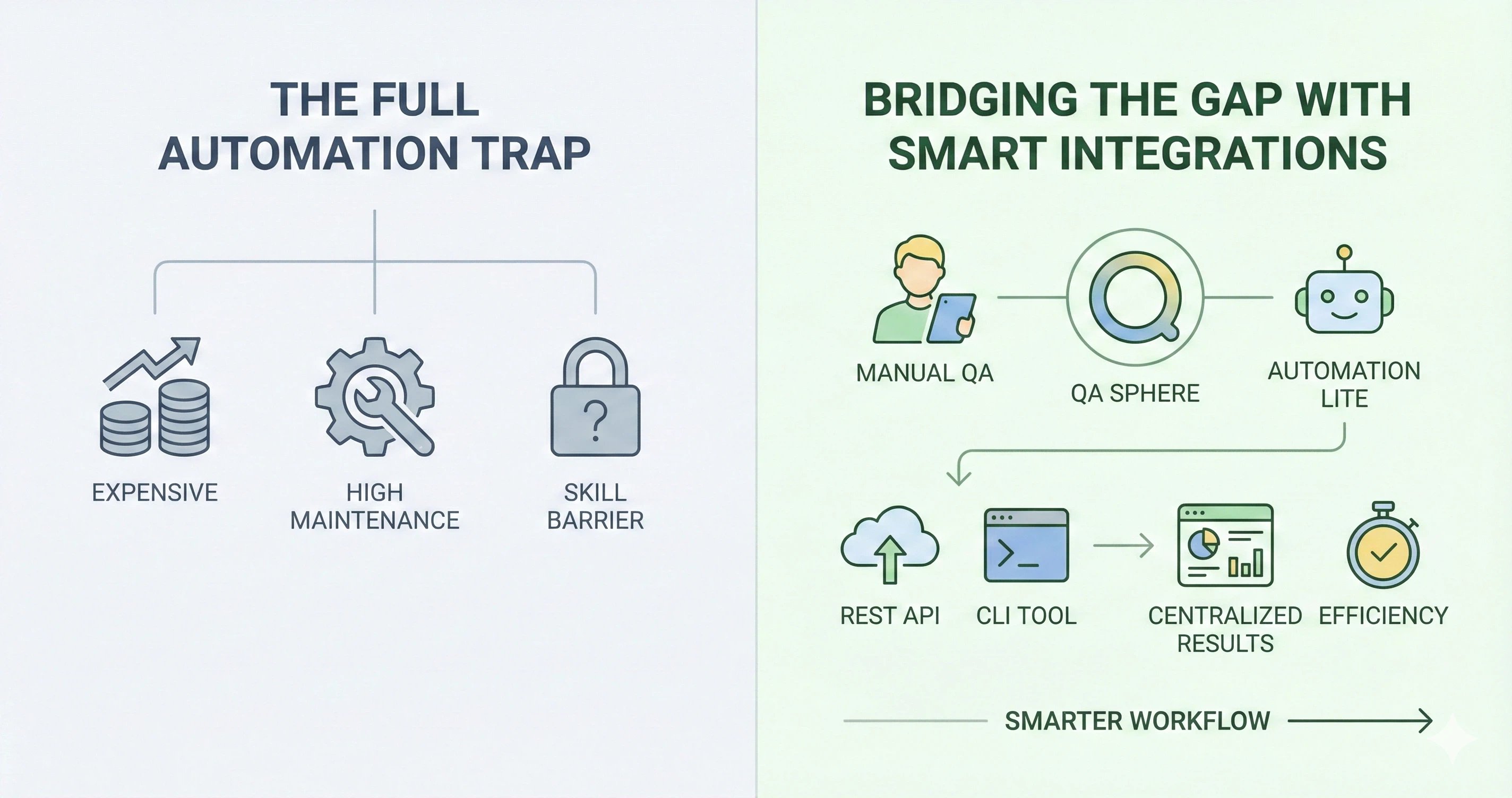
If you're going to automate, pick tests that are stable and repetitive. Don't waste time automating complex, ever-changing workflows; instead, automate things like basic login checks or frequently tested core functions. Then, use QA Sphere's integrations to bring those results into your central test management tool.
Centralize Everything
The real power of these integrations is keeping everything in one place. By bringing your automated results into QA Sphere alongside manual test cases, you create a single source of truth. This means you don't need to jump between tools or rely on spreadsheets to track test results.
Wrapping Up
The drive to automate is real, and the benefits are clear—but full automation isn't a one-size-fits-all solution. For QA teams that can't, or don't want to, go all-in on automation, tools like QA Sphere offer a middle ground. By using integrations that pull in the best of both worlds, you can streamline your workflow, centralize results, and make manual QA more efficient.
Automation might be the buzzword of the moment, but smart integrations? That's the real win. So, if you're looking to bridge the gap, take a look at QA Sphere. It's about working smarter, not harder—and getting the job done without the headaches.
Upcoming Blog Articles
-
"The Hidden Costs of Not Prioritizing Test Case Management"
This article would address the often-overlooked impact of ineffective test case management. Poor organization and prioritization can lead to duplicated tests, wasted resources, and bloated test suites that are difficult to maintain. By exploring the hidden costs, such as reduced productivity and inflated testing times, the article would appeal to decision-makers who are interested in optimizing budgets and resources. It would introduce QA Sphere's capabilities in organizing, tagging, and prioritizing test cases, presenting the platform as a solution to prevent these hidden costs from affecting a team's overall efficiency. -
"Beyond Bug Tracking: How QA Can Drive Product Innovation"
This topic explores the evolving role of QA in product development, highlighting how QA teams can go beyond their traditional role of bug tracking to become drivers of innovation. The article would discuss how QA insights contribute to user experience improvements, performance optimizations, and product evolution. QA Sphere can be presented as a tool that enables this shift, offering data and insights that help QA teams contribute directly to product strategy, reinforcing the idea that QA is a critical part of product innovation and not just a checkpoint before release. -
"Top Testing Myths That Are Holding Your Team Back"
This piece would address common misconceptions in the testing world, such as "more tests mean better quality" or "only developers need to know code." By debunking these myths, the article could challenge outdated ideas that may be limiting a QA team's potential. It would encourage readers to embrace a more strategic approach to testing, showcasing QA Sphere as a platform that supports a modern, efficient, and well-rounded QA process. This approach makes the article thought-provoking, engaging readers looking to modernize their QA practices. -
"From Startups to Enterprises: How Test Management Needs Evolve with Growth"
This article would look at the journey of test management from small teams in startups to complex departments within large enterprises. By exploring how QA needs change with a company's growth, the article can engage readers with practical strategies for scaling their testing efforts. It can also highlight QA Sphere's adaptable features, showing how the platform grows alongside an organization, from the needs of a lean startup to the demands of an enterprise-level QA department.

Written by
Nick Lapis-TroutNick Lapis-Trout writes about the practical challenges of software testing, from automation strategy to embedded systems QA.