
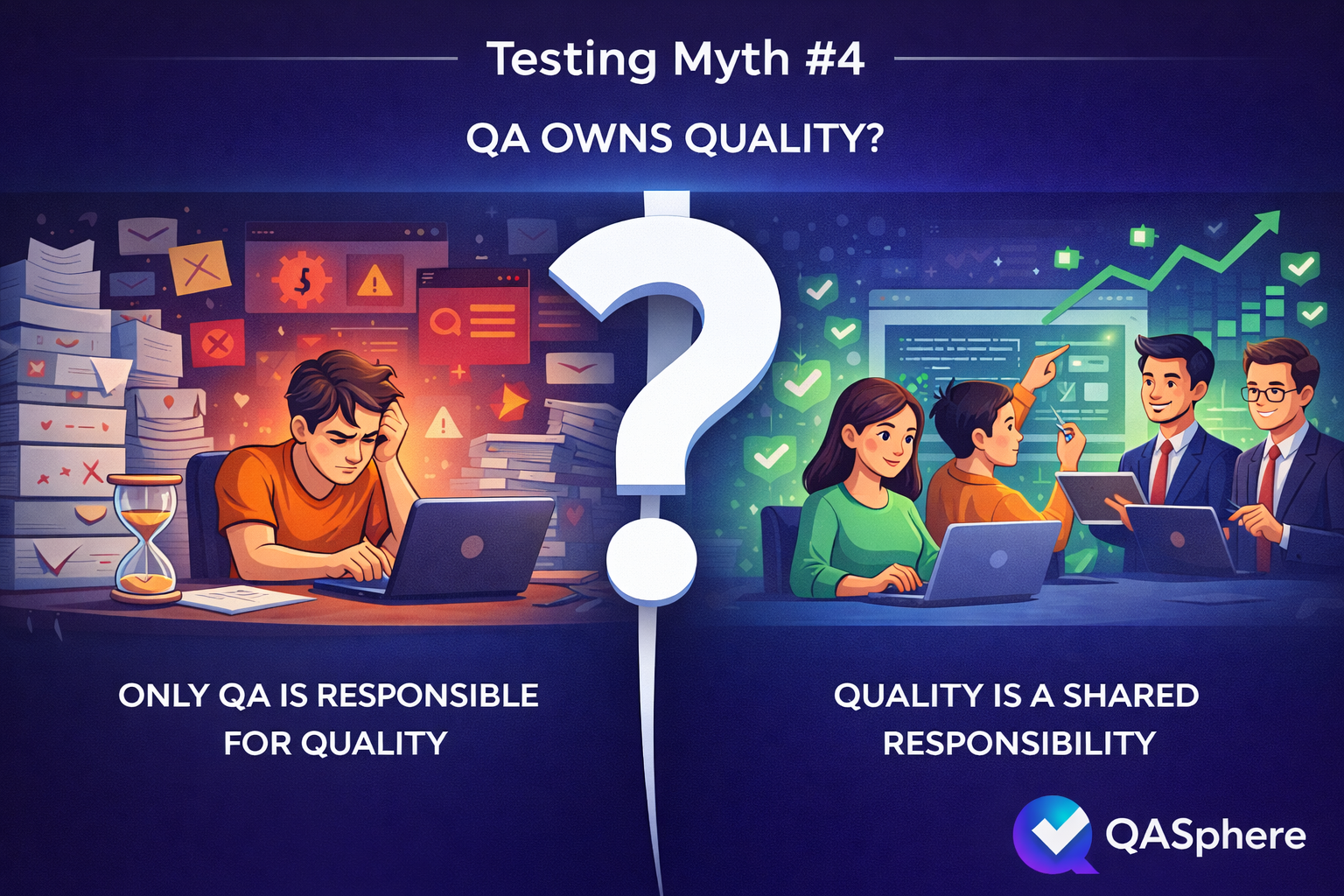
Testing Myths #4: QA Owns Quality

Part of the Testing Myths series. Testing Myths #4.
You cannot inspect quality into a product after the fact.
Deming made essentially this point in his fourteen points for management: quality has to be built into the system, not checked into it at the end.
By the time QA sees a feature, many of the most important quality decisions have already been made: how clear the requirements were, how risky the architecture is, how observable the system will be, how carefully the change was implemented, and how much ambiguity the team left unresolved. Testing can expose the consequences of those decisions. It cannot retroactively make those decisions good.
More than forty years later, most software teams still have not internalized this. They have QA departments, test cycles, release gates, and defect trackers. What many of them do not have is a shared sense that quality belongs to everyone who shapes the product. Instead, they have concentrated that ownership onto a single function — and then wondered why their release confidence is fragile.
How quality ownership gets concentrated
The pattern usually develops without anyone deciding it. It grows from how work is organized.
Development teams work in sprints or cycles that end with a handoff. Somewhere in the delivery chain, there is a moment where finished work passes to another party for verification. Once that handoff becomes routine, something shifts quietly in how people think about their own role. Developers start treating QA review as the check on their work rather than a supplement to their own verification. Product managers stop writing acceptance criteria that are testable and start writing them in terms of intent, assuming QA will figure out the specifics. Leadership starts measuring QA throughput — bugs found, cases run, blockers raised — and treats it as a proxy for quality overall.
QA, for its part, often accepts this. Testers are good at finding problems, so they find problems. They build elaborate test suites. They track defects. They write risk summaries. They own the spreadsheet or the tool that tells the team what was tested. And gradually they become the function the organization relies on for all quality-related answers, including answers they were never positioned to give — like whether the original requirements made sense, or whether the architecture would hold under load, or whether the rollout plan was realistic.
This is how QA becomes a blame sink. Not through malice or poor hiring, but through a structural pattern where one function absorbs the visibility of quality problems without the authority, upstream access, or organizational mandate to prevent them. When something ships broken, QA is the obvious place to point. The myth that QA owns quality converts responsibility for the entire system into accountability for the one team most visibly associated with defects.
Why this model fails
The failure is easy to see in practice.
If quality belongs to QA, developers are tempted to rely on handoff instead of self-verification. Product managers are tempted to leave acceptance criteria fuzzy and let QA sort it out later. Designers are tempted to stay out of edge-case behavior because "QA will catch it." Leadership is tempted to turn release pressure into a QA problem because QA is the most visible checkpoint.
That model creates three predictable results: problems are discovered late, release decisions get distorted, and QA becomes a blame sink for issues that originated much earlier in the system.
A better responsibility model
The practical question is what distributed quality ownership actually looks like at the role level. It is not complicated, but it requires each function to hold a genuine piece of the work.
Product owns clarity. Quality problems that originate in ambiguous requirements, unstated assumptions, or misaligned acceptance criteria are product problems first. If a developer builds something that passes QA but does not match what users needed, that is not a testing failure. It is a requirements failure. Product teams that write testable, specific acceptance criteria and participate actively in defining what confidence looks like for a feature are practicing quality ownership.
Engineering owns build quality and technical risk. Developers who treat QA review as their primary safety net are outsourcing their judgment. Strong engineering quality ownership means writing code that is testable by design, doing meaningful self-verification before handoff, building in observability, and raising architectural risks early rather than leaving them for someone else to discover in a test run.
Design owns interaction quality and usability intent. UX decisions shape a large category of quality outcomes that neither automated testing nor functional QA is well-positioned to catch. When design is absent from quality conversations — when testers are left to interpret intended behavior from Figma files and guesswork — edge cases and usability gaps get discovered late, if at all.
Leadership owns tradeoffs and release appetite. The decision to ship with known issues, to defer a fix, or to delay a release is not a QA decision. QA provides the evidence and the risk framing. The judgment call about acceptable risk belongs to people with the business context and the authority to make it. Organizations that push this decision onto QA are placing it in the wrong hands.
QA owns testing strategy, risk visibility, and feedback quality. This is a significant responsibility — not a diminished one. Knowing what to test, how to surface risk, how to make quality evidence useful to the whole team, and how to build a testing practice that scales with the product is hard, expert work. The point is that it is not the entirety of quality ownership. It is one critical contribution to a shared effort.
Making shared ownership operational
The cultural argument for shared ownership is easy to accept in principle and easy to abandon under deadline pressure. What keeps it from collapsing is operational infrastructure — specifically, whether quality evidence is visible to everyone who shares responsibility for it.
When QA is the only function with access to test status, defect history, coverage gaps, and release risk summaries, the organization will keep behaving as if QA owns quality regardless of what anyone says in retrospective meetings. The information asymmetry recreates the ownership asymmetry.
This is the practical case for tooling that makes quality state legible across the team. Reporting moves quality conversations from opinion to evidence — developers, product managers, and leaders can see what was tested, what failed, and what risk is open without asking QA to narrate it. Issue tracker integration connects test status directly to defects, so the relationship between what was found and what was fixed is visible in the same tools engineers already use. Test runs make release readiness accessible beyond the QA function, so the ship decision can reflect genuine shared awareness rather than a summary passed along a chain.
Shared visibility does not automatically produce shared ownership, but the absence of it almost guarantees that ownership will stay concentrated. When the whole team can see the quality picture, the whole team starts acting like it belongs to them.
The sharper version of the myth
QA does not own quality alone. What QA owns is the practice of making quality visible, testable, and discussable — which is what allows everyone else to own their part effectively.
That distinction is worth holding onto. The myth is not just unfair to testers. It is a bad design for software delivery. If a team wants better quality, it has to build that into the work long before QA runs the first serious test session.