
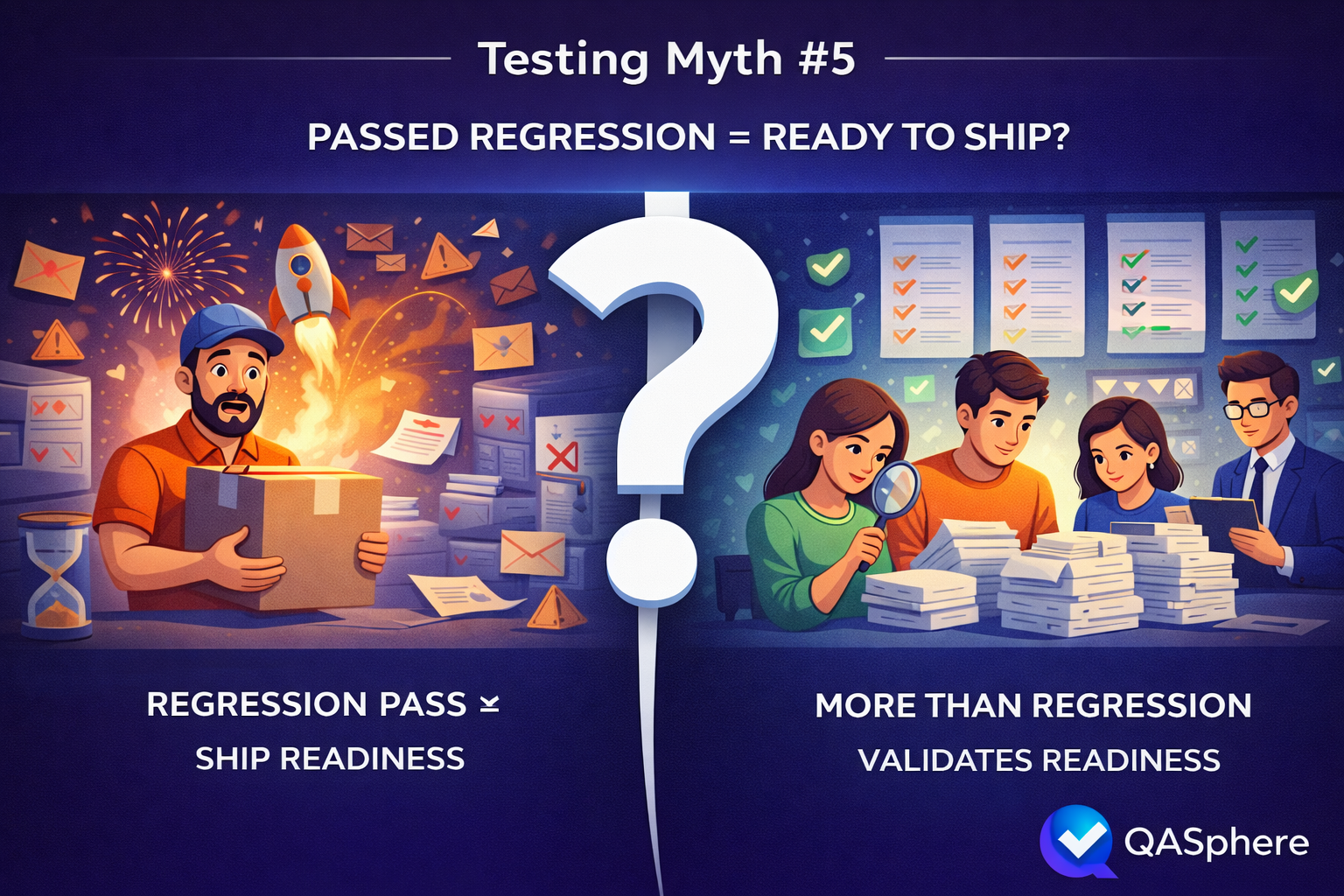
Testing Myths #5: If It Passed Regression, It's Ready to Ship

Part of the Testing Myths series. Testing Myths #5.
Imagine a release where the regression suite goes green, the team ships, and two hours later a payment flow fails in production for customers in one region. The trigger is a locale-sensitive formatting change that never existed in the test data and never showed up in staging. The regression run told the team nothing false. It simply told them far less than they assumed.
That gap — between what regression confirms and what a release actually requires — is where this myth lives.
What regression actually protects
A regression suite protects known behavior. It is built from historical test cases, previous defects, and patterns that someone decided were worth encoding. When it runs clean, the signal is real: the product has not broken in the specific ways the suite was designed to detect.
That is a meaningful constraint. It is not a comprehensive one.
Regression is confirmation, not investigation. It can only find what the suite was designed to find. A green run does not mean nothing is wrong. It means the anticipated failures did not occur under the conditions the suite covered.
That is why teams get into trouble when regression becomes the main quality story. Usually it is compensating for weaker signals elsewhere: thin change-based testing, poor scope analysis, weak exploratory coverage, or fragmented release communication. Regression ends up carrying more meaning than it was ever built to carry. Michael Bolton makes a similar point in Regression Testing and Discipline, where the real issue is not regression itself but over-dependence on it.
This is worth sitting with. It is not that regression is bad. It is that its value is bounded — and treating a clean run as a release verdict asks regression to answer questions it was not designed for.
The gaps regression doesn't close
A regression suite, however well-maintained, leaves several categories of risk consistently unaddressed:
New risk not in the suite. Every release introduces some scope that the historical test pack was not built to cover. The suite reflects past risk; the current release introduces present risk. A green run cannot confirm that new or changed functionality behaved correctly under conditions the suite never modeled. If the team did not run focused change-based testing on top of regression, they have a blind spot.
Environment differences. Test environments are approximations. Data shape, locale settings, third-party sandbox behavior, permission structures, and migration side effects can all diverge from production in ways that only appear under real conditions. A payment flow that worked cleanly in staging may fail in production because production carries years of edge-case account data that no test environment replicates.
Unresolved known issues. A release can pass regression while still containing open defects that someone accepted, deferred, or simply forgot to flag. Ship readiness is partly a question of which known problems the team is choosing to live with. That judgment has to be made explicitly — it does not emerge automatically from a test result.
Shallow signal depth. Regression checks that a flow completes, not that it is adequate. A checkout flow can pass every assertion in the suite and still have degraded performance, insufficient error messaging, incomplete logging, or broken behavior under network conditions the suite never simulated. The checks being green is not the same as the feature being ready.
A release readiness checklist
When the regression run finishes, these are the questions worth working through before the release call:
- Did regression cover the established critical paths, and did all of them pass?
- Did we run focused testing on everything new, changed, or removed in this release?
- Are there open defects in this release? Who reviewed them, and who accepted the risk?
- Have we checked for environment or data dependencies that production exposes but staging does not?
- Do we have sufficient monitoring and alerting in place to detect problems quickly after the deploy?
- Is rollback feasible if something goes wrong? Is the team aligned on what would trigger it?
- Are there downstream dependencies — other services, scheduled jobs, third-party integrations — that need to be verified post-deploy?
- Does the support team know what is shipping, and are they prepared for the most likely failure modes?
None of these questions belong to regression. Together they produce a more defensible answer to the actual question: is the team ready to ship responsibly?
If your team wants a sharper starting point for the regression piece of this, Regression Testing With QA Sphere covers practical setup. The checklist above is the layer on top.
Execution visibility at the release boundary
This is the moment where fragmented tooling causes the most damage. The team knows pieces of the truth: test results in one system, defect status in another, scope decisions in a product doc, and the actual ship conversation happening in chat under deadline pressure. The release call gets made from incomplete information not because the team is careless, but because the information is not assembled anywhere.
Test runs in QA Sphere make it easier to separate milestone regression from change-focused execution, so the two types of evidence stay distinct rather than collapsing into a single pass/fail count. Reporting surfaces a release-facing view of what actually ran, what passed, and what did not — rather than a vague sense that things looked mostly fine. And issue tracker integration closes the loop between test results and defect status, which is the gap where the most consequential misreads happen: teams that declared ready-to-ship without realizing their open issues and their test outcomes were not telling the same story.
The judgment call is still the team's. Better tooling makes the judgment better informed.
Regression passed is not a release verdict. It is one piece of a larger picture. The question to ask before shipping is not whether the suite went green — it is whether the team, looking at all available evidence, can defend the decision to release. Sometimes regression will be a big part of that answer. The mistake is letting it be the whole thing.