
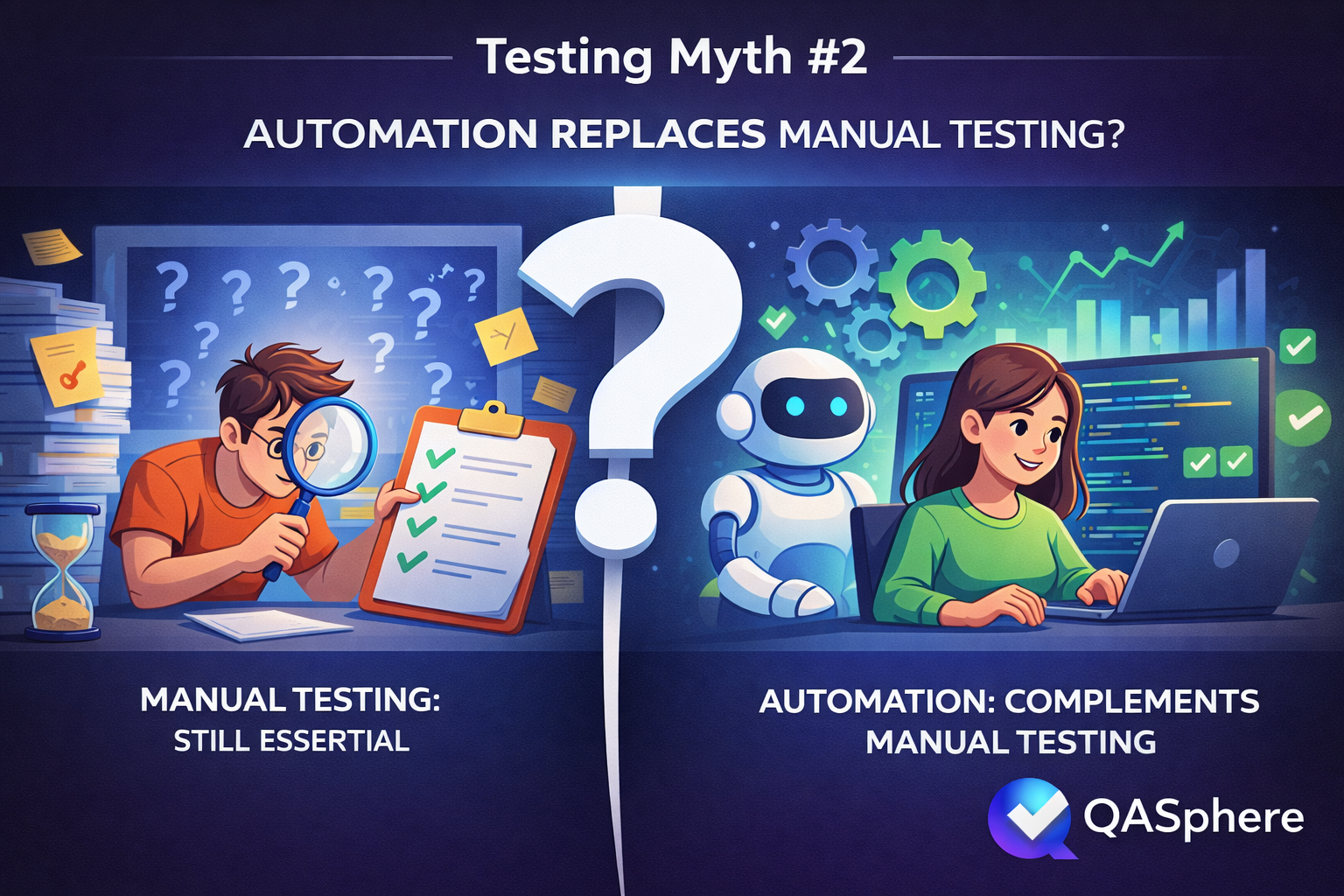
Testing Myths #2: Automation Should Replace Manual Testing

Part of the Testing Myths series. Testing Myths #2.
Picture a fintech startup building a payments product. They spend a year automating aggressively. They have a strong CI pipeline, unit tests at every layer, end-to-end scripts for their most critical flows, and a dashboard showing 94% coverage. Their deployment frequency goes up. Their confidence goes up. They let their two manual testers go because, as an engineering lead puts it, the scripts are doing the same job.
Six months later they ship a currency conversion screen that displays the wrong decimal separator for European locales. The automated checks pass because the logic is technically correct for the assumed locale. Nobody explored the edge of that assumption. A customer catches it in production. Then another customer. By the time it surfaces in a support ticket, the problem has been live for weeks.
The scripts were not broken. The coverage was real. But the team had no one left who was paid to sit with the product, move through it with curiosity, and ask what might be wrong that nobody had thought to specify.
What automation is actually good at
Automation is strong at a specific, important category of work: verifying that known behaviors still hold. Once a team understands a flow and encodes that understanding into a check, automation runs it faithfully, cheaply, and at a frequency no human team could match. That is genuinely valuable.
The cleanest way to think about it is this: automation is excellent at confirmation. It confirms that a known behavior still behaves as expected. That is why the old testing vs. checking distinction is still useful. Automation is strongest where the team already knows what should happen and wants to verify it repeatedly.
That distinction is not a demotion. Good checking at scale is hard to build and worth protecting. Automated regression suites catch silent breakage in core flows. Contract tests catch interface drift between services. Load tests reveal degradation before it becomes an incident. Data integrity checks surface corruption that no human would notice in a sprint review. These are important contributions to quality, and they compound over time as the product grows.
The error is categorical, not technical. When teams say automation should replace manual testing, they are not describing a better version of the same thing. They are eliminating a different kind of work entirely.
What only humans can do
Exploratory testing matters because it combines learning and execution in real time. A person notices something odd, changes direction, follows the thread, and updates their mental model while they are still in the product. That is not a slower form of scripted execution. It is a different cognitive activity altogether.
Scripts confirm. Humans inform. Scripts tell you whether expected behavior still matches the assertions you encoded. Skilled testers tell the team what the product is actually like right now, including the parts nobody specified clearly, the assumptions that quietly broke, and the strange interactions between features that nobody modeled.
Concretely, humans catch things scripts reliably miss:
- Tone and coherence problems. An error message that is technically accurate but misleading in context. A confirmation dialog that says "Are you sure?" without telling the user what they are confirming or what happens if they are not. Scripts verify that the message exists. Humans notice it makes no sense.
- State drift. A UI that is technically correct at each step but gets progressively inconsistent through a long workflow. The script passes each assertion. The person doing the session feels something is off by step eight, backtracks, and finds the source.
- Cross-feature interference. A new notification system that fires correctly in isolation but doubles up with an existing alert in a specific permission configuration that nobody thought to test together. Scripts test features. Experienced testers test the product as a whole.
- Specification blindness. The whole category of risks that live in what was never written down. The original currency conversion problem described above was not a logic error. It was an assumption so obvious to the developer that it was never written as a requirement, and therefore never encoded as a check.
No amount of additional automation surface area closes these gaps. The gaps are definitionally outside the envelope of what the scripts were built to confirm.
The hybrid model in practice
Mature teams usually converge on a similar structure, even if they do not describe it in those terms:
- Automated checks cover stable, high-value flows and are treated as infrastructure. They run constantly, fail loudly, and are maintained like production code.
- Exploratory work runs alongside active development, especially early in a feature's lifecycle before behaviors have stabilized and before the right checks are even obvious.
- Release-time testing involves human judgment applied specifically to the risk surface that has changed since the last deployment — not a full regression, but a targeted investigation of what is new, adjacent to what is new, or known to be fragile.
- The boundary between "automate this" and "keep this manual" is revisited regularly, because it shifts as the product matures and as the cost of maintenance changes.
The Manual Testing vs Automation Testing question is ultimately about this allocation. The answer is not a fixed ratio. It is a habit of asking, for each area of the product, which kind of work generates more useful information right now.
Making the split visible
One of the practical reasons this myth persists is that automated and manual work often live in different systems. CI dashboards show pass/fail counts. Manual execution happens in a spreadsheet, or a wiki page, or someone's notes. When decision-makers see the automation dashboard but not the manual picture, the automation looks like the whole story. Manual work becomes invisible, and invisible work is easy to cut.
The operational fix is to make both kinds of work visible in the same context. Test runs in QA Sphere let teams track manual execution and automated result imports alongside each other, so release decisions reflect the actual coverage picture — not just the part that runs in a pipeline. Reporting surfaces the full state: what was checked automatically, what was explored manually, what failed, and what was not covered at all. Issue tracker integration keeps defects connected to the test activity that found them, which matters because the most significant bugs are often the ones that came from exploratory sessions rather than scripted checks.
When both kinds of work share the same visibility layer, a different kind of conversation becomes possible. Instead of asking "can we automate this?", teams start asking "what is this test activity actually telling us, and which tool generates that information better?" That is the conversation that leads to genuinely better coverage rather than the illusion of it.
Automation is not the goal. Confidence in the product is the goal. Some of that confidence comes from fast, algorithmic verification at scale. Some of it comes from a skilled person spending time with the product and trusting their own judgment about what they observe. Teams that mistake the first for the whole thing will keep shipping what their scripts could not see.